
For Noggin, a core technical foundation was built around a custom networked entity architecture designed to coordinate all in-game items and characters. This system managed synchronization across the game state, ensuring that entities remained consistent and responsive in networked environments. By centralizing entity ownership and state replication, it established a scalable backbone for multiplayer interaction and future extensibility.
On top of this foundation, an interaction framework was implemented through a comprehensive drag-and-drop system. This system supported a wide range of entity-to-entity and player-to-entity interactions, enabling flexible manipulation of objects within the game world. It was designed to be extensible, allowing new interaction types to be added without restructuring core logic, while maintaining predictable behavior across both local and networked contexts.
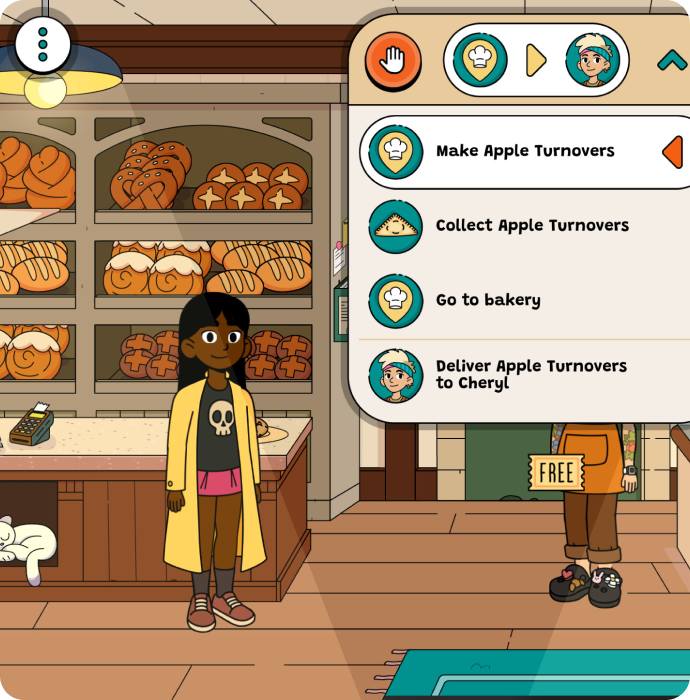
In parallel, a hierarchical save/load system was developed to preserve complex scene and entity relationships across sessions, ensuring persistence of world state at multiple levels. Complementing this, a quest and dialogue system was implemented to support structured gameplay progression, narrative delivery, and persistent player progress tracking. Together, these systems formed the gameplay backbone of Noggin, enabling both systemic interaction and narrative continuity within a unified framework.
Additional infrastructure was also established to support entitlements and in-app purchases, laying the groundwork for future monetization systems and user progression features tied to ownership and access control. This included designing systems capable of securely tracking player entitlements and integrating them into gameplay logic in a modular way, without tightly coupling them to core gameplay systems.
Overall, this work provided valuable experience in building large-scale, networked game systems with extensible architecture. It demonstrates applied understanding of scalable multiplayer design, persistent world state management, and systems that support user-generated content and long-term live service evolution, all while maintaining modularity and performance constraints required for production environments.